Latency
Voice-to-voice latency is the time from the moment the caller stops speaking to the moment the caller hears the first audio of the reply. Every turn of a call adds up the same stages. This page explains each stage, shows measured numbers, and lists the settings that lower the total.
The stages of one turn
| Stage | What takes time | Where you set it |
|---|---|---|
| Network and telephony | Audio travels from the caller to the carrier, to Moveo, and back. | The Moveo region and the telephony region |
| Noise suppression | The denoiser cleans the caller audio before speech-to-text. Off by default. | Noise suppression of the voice integration, for example Telnyx Voice |
| Speech-to-text finalization | The speech-to-text model turns the last words into a final transcript. | Speech-to-text row of the AI Agent voice settings |
| Turn detection wait | Moveo or the model waits for silence or for a confident end of turn. | Turn detection settings in the speech-to-text row of the AI Agent voice settings. See Turn-taking. |
| LLM first token | The AI Agent builds the reply and the language model streams its first token. | Voice channel of the model strategy |
| Text-to-speech first audio | The text-to-speech model returns the first bytes of audio. | Text-to-speech row of the AI Agent voice settings |
The AI Agent streams its reply. Text-to-speech starts on the first part of the reply, so the caller hears the reply before the language model finishes it.
What Moveo measures
Moveo records these values for every turn of a call:
| Measure | What it covers |
|---|---|
| End-of-turn delay | The time from the end of the caller speech to the end of the turn. |
| Speech-to-text latency | The time from the end of the caller speech to the final transcript. |
| LLM time to first token | The time from the request to the first token of the language model. |
| Text-to-speech first byte | The time from the text-to-speech request to the first audio bytes. |
| Turn total latency | The time from the end of the caller speech to the first audio of the reply. |
The network legs and the carrier buffers are outside these measures. The console does not show these measures. To get them for your calls, contact Moveo support.
Latency by region
The table shows the typical voice-to-voice latency of a turn in each Moveo region. Moveo measures from the end of the caller speech to the first audio of the reply that leaves Moveo. The network legs and the carrier buffers add more time to what the caller hears.
| Region | Typical turn |
|---|---|
United States (us-central) | About 1.1 s |
Europe (eu-central) | About 1.2 s |
Brazil (sa-east) | About 1.3 s |
These values are estimates, not limits. Each AI Agent has its own speech models, language model and tools, and each one changes the total.
Reduce latency
Check these settings in order. Each one changes a stage of the table above.
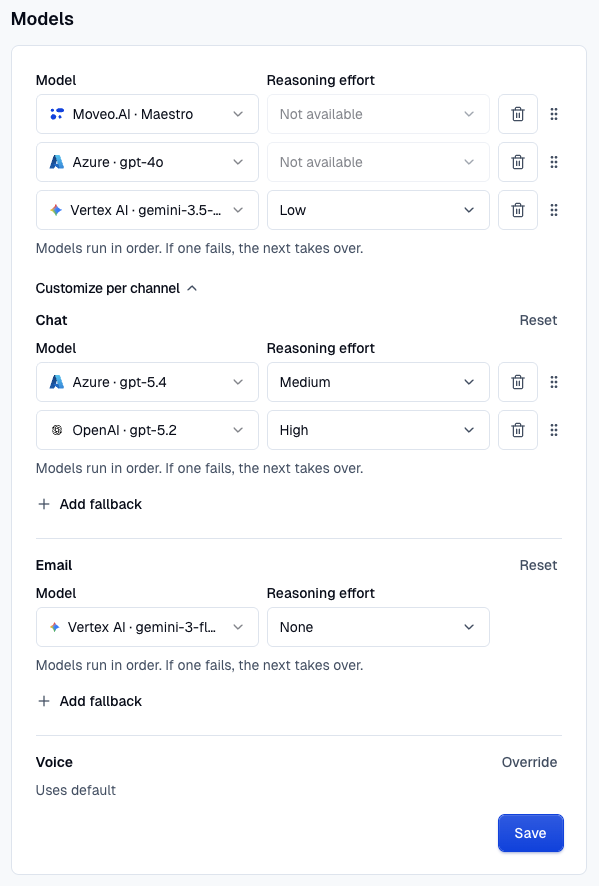
- Language model. Pick a fast model for the Voice channel of the model strategy. Voice uses one model and no fallbacks.
- Reasoning effort. Set Low or Medium on the voice model. High reasoning effort on voice often pushes the response time past four seconds.
- Turn detection. In the speech-to-text settings of the primary language in the voice settings, make your model end turns sooner. For Deepgram Flux, lower the Patience Threshold or the End-of-Turn Timeout. For Soniox, lower the Max Endpoint Delay or raise the Endpoint Sensitivity. For ElevenLabs, lower the VAD Silence Threshold, because every turn waits for it. A turn that ends sooner can cut off callers who pause. See Turn-taking.
- Text-to-speech model. Pick a fast model in the text-to-speech row of the AI Agent voice settings. For MiniMax, English normalization improves numbers and dates at a small latency cost.
- Noise suppression. Noise suppression adds a small latency to every turn. Keep Noise suppression off in the voice integration for quiet lines, and turn it on for lines with background noise.
- Region. Use the Moveo region closest to your callers. For Twilio Voice, the Twilio region must match the Moveo region. See Twilio Voice.
- Reply length. Keep voice replies short. Write the first sentence of a reply as a direct answer.
- Tools. A tool call adds its own run time to the turn. For a slow MCP tool, set Speak before the tool to Always. The AI Agent then says a short line, for example a request to wait, before the tool runs. See Turn-taking.
The first turn of a call is slower than the next turns. Measure latency on turn 2 and later, and compare the same phrases across settings.