Payment recovery campaigns
Overview
A payment recovery campaign contacts people with overdue balances and works toward a resolution, such as a promise to pay or a completed payment. It is one of two campaign types, alongside Outreach. For shared concepts, see the Campaigns overview.
Payment recovery pairs an audience of debtors with an AI Agent that follows up, sends reminders, and adapts its messaging per contact. When you enable autonomous actions, the agent decides the best next step for each person instead of following a fixed message sequence. A compliance profile keeps that contact within the rules that apply to your region.
Key concepts
- Campaign type — Payment recovery is a dedicated type built for regulated debt collection. It captures debt details per contact for reporting and for the AI Agent to act on.
- AI Agent — A Debt Collection agent handles replies, negotiates options, and generates payment links. Build one first with the Build your first AI Agent guide.
- Autonomous actions — An optional capability that lets the agent choose the channel, message, and timing for each contact. See Autonomous actions.
- Compliance profile — A set of protections that block or delay contact when regulations require it. You select one when autonomous actions is enabled. See Compliance profiles.
Before you start
- Build and publish a Debt Collection AI Agent to handle replies.
- Confirm that your messaging integrations are connected and active.
- Prepare a CSV of debtors with the required debt fields. See CSV format reference.
- If you plan to use autonomous actions, decide which compliance profile applies.
Step 1 - Set up the campaign
- Go to Campaigns and click + Create.
- Select Payment recovery as the campaign type.
- Enter the campaign name. The system generates a matching tag from this name for filtering conversations. Add more tags for reporting or routing as needed.
- Upload your CSV. Click Download template file to get a template with the required debt columns. The audience table previews every row and flags issues, such as missing contact details or unmapped required fields.
- Match each CSV column to a field. The platform suggests mappings automatically; adjust any that are wrong.
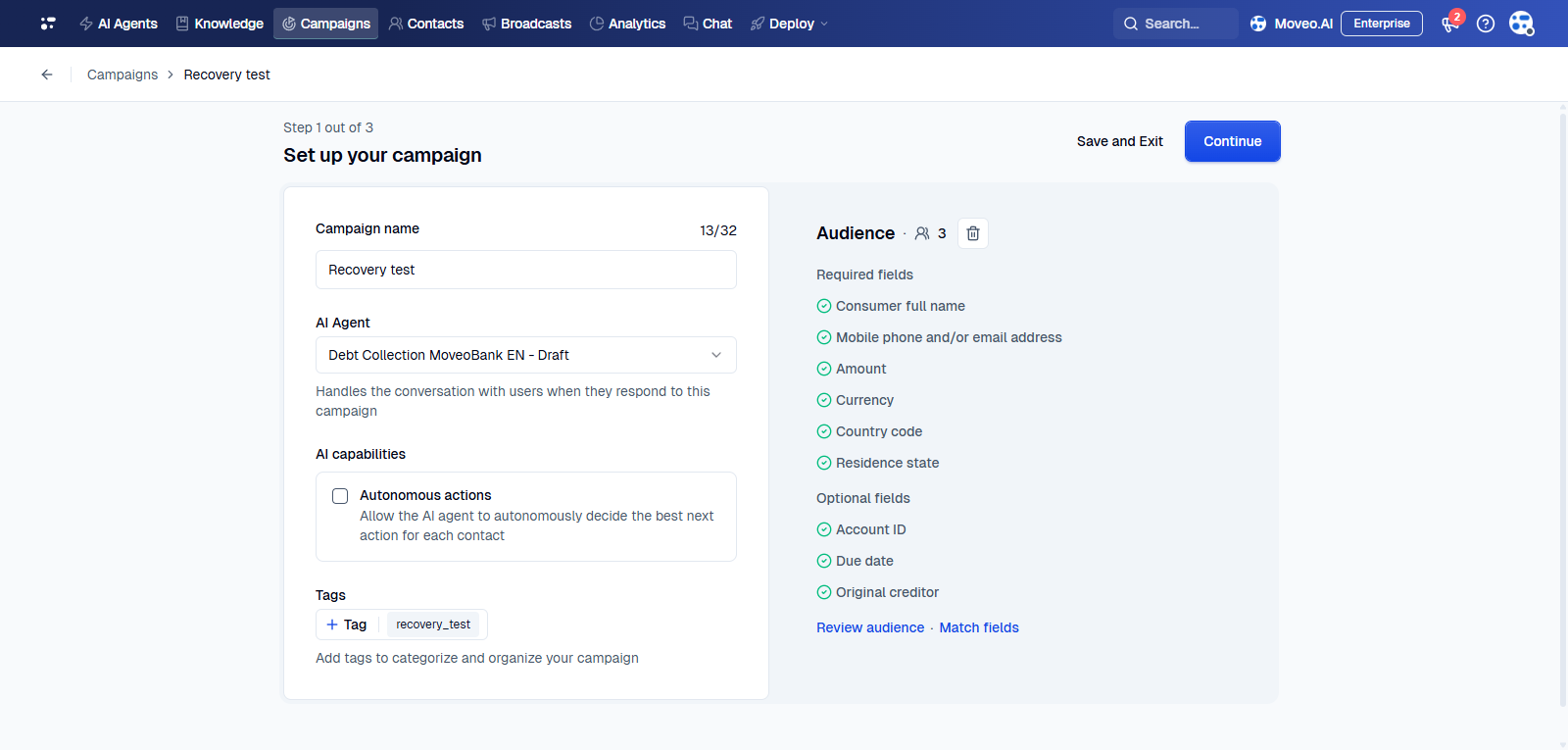
If a required field stays unmapped, the setup step keeps the warning active until you map it. Optional fields can be skipped.
Turn on autonomous actions
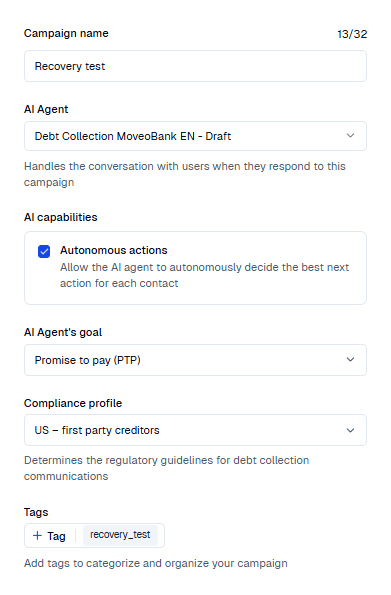
Under AI capabilities, turn on Autonomous actions to let the agent decide the best next action for each contact. When enabled:
- A Goal is required. Select it from the dropdown — it defines what a successful conversation achieves, such as Promise to pay (PTP) or Claim of payment.
- A Compliance profile is required. It applies the contact rules for your region, such as quiet hours, frequency caps, and stop-contact requests.
- The agent uses next-best-action logic to pick the channel and message per contact, rather than a fixed sequence.
- An optional Evaluate first message checkbox shows. Select it to make the agent approve the first message to each contact before it goes out. See Evaluate first message.
For the full behavior and how it differs from a standard campaign, see Autonomous actions.
Step 2 - Build the message journey
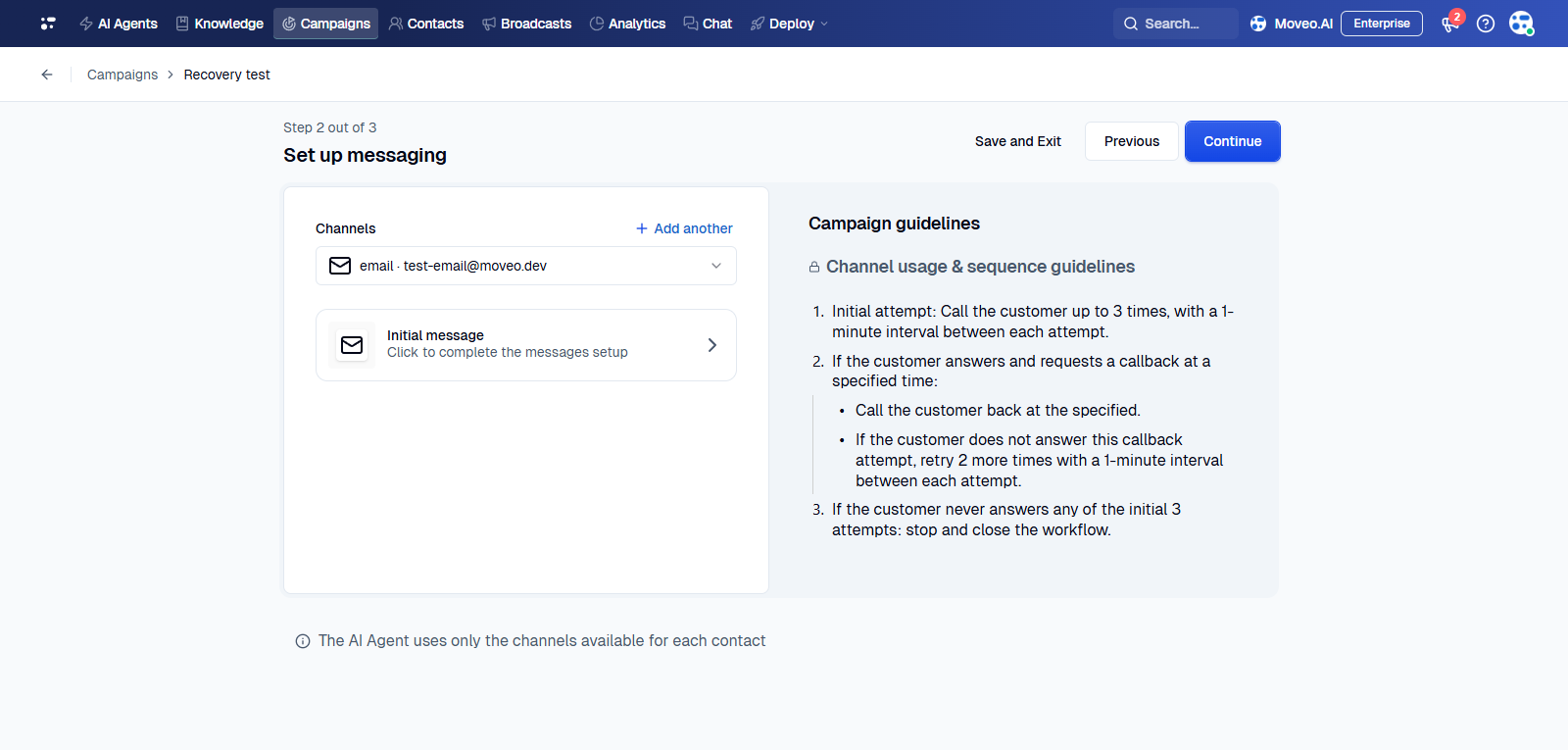
The messaging step depends on whether autonomous actions is on:
- Autonomous actions on — Choose the channels the agent may use, then write the initial message. The Campaign guidelines panel holds the editable rules that shape how the agent sequences its attempts. The agent picks the channel, message, and timing per contact, and uses only the channels that contact has.
- Autonomous actions off — Build a fixed journey: a primary message, a fallback for failed deliveries, and a follow-up for silent contacts, as described for Outreach campaigns.
Step 3 - Review and launch
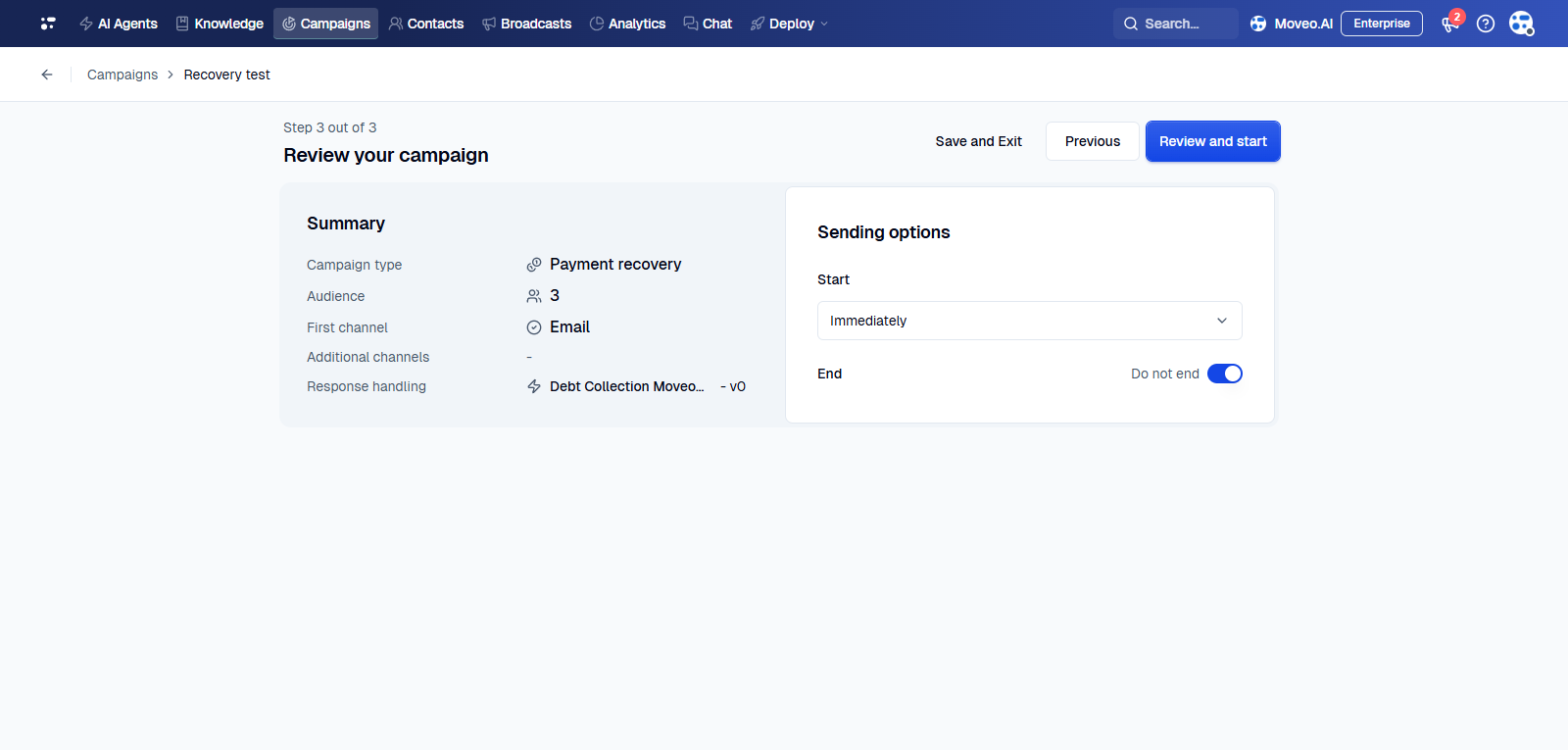
The review screen summarizes the audience, messaging, and scheduling. The layout adapts to the campaign:
- Agentic review — Shows the campaign type, the audience, the channels, and the AI Agent that handles responses.
- Standard review — Shows the primary message, delivery fallback, and no-reply follow-up.
In the Start dropdown, choose Immediately to launch as soon as you confirm, or Schedule for later to set a date, time, and timezone. Click Review and start to open the confirmation modal, then Start campaign to launch. Click Save and Exit to keep the campaign as a draft.
CSV format reference
Each row represents one debtor. Map every required field during setup.
The required fields do more than identify each debtor. They power payment-recovery-specific analytics, such as the total amount due across your audience. When autonomous actions is enabled, the AI Agent also uses the amount and currency to personalize messages and decide the next best action. The optional due date and original creditor add further context to those messages when you provide them.
Required fields
| Field | Description |
|---|---|
| Consumer full name | Full name of the debtor |
| Contact | At least one of phone or email |
| Amount | Outstanding balance |
| Currency | Currency of the balance |
| Country code | Two-letter ISO country code for the debtor, such as US |
Optional fields
| Field | Description |
|---|---|
| Account ID | Unique identifier for the account |
| Due date | Date the balance became due |
| Original creditor | The creditor the debt originated with |
| Residence state | Two-letter state code, used to apply state-level compliance rules. Required when the country code is US or BR |
Provide clean, one-value-per-cell entries and keep account identifiers unique. Rows missing both a phone and an email are rejected.
Compliance and safety
When autonomous actions is enabled, a payment recovery campaign runs under a compliance profile that enforces contact rules for your region, such as quiet hours, frequency caps, and stop-contact requests. During live conversations, the AI Agent applies further guardrails, such as stopping collection when a consumer disputes the debt or reports identity theft.
Compliance protections take precedence over custom instructions and guidelines. Compliance profiles assist with regulatory compliance but are not a substitute for legal counsel.
After launch
- Track campaign status from the Campaigns list. Open a campaign to view subscriber activity and message logs.
- Read the recovery, promise, and call metrics on the Performance tab.
- Review disputed debts and stopped subscribers on the Performance tab, under Barriers to progress.
- Filter conversations by the campaign tag for reporting.